

The Federal Court's recent decision in OrthAlign, Inc v Navbit Pty Ltd [2026] FCA 1542 illustrates how differences in the physical design of a product can be decisive in determining patent infringement, even where the product performs essentially the same function as the patented invention.
The dispute concerned a surgical navigation system used in hip replacement surgery. Although the claimed invention and the competing device were both designed to assist surgeons in positioning artificial hip components, the Court found that Navbit's competing device did not infringe OrthAlign's patent because it lacked a particular structural feature required by the claims.
The decision highlights the importance of precise claim drafting and the potential for competitors to design around particular structural limitations, even where their products achieve a similar result.
OrthAlign, Inc. is the registered owner of Australian Innovation Patent No. 2022100061, titled Hip Replacement Navigation Systems and Methods.
The patent related to a surgical navigation system designed to assist surgeons in accurately positioning the acetabular cup of an artificial hip joint during hip replacement surgery.
In particular, independent claim 1 was directed to a hip joint navigation system comprising an impactor adapter and an inertial navigation device.
The impactor adapter included a clamp at one end for attachment to a surgical impactor and a coupler at the other end for attachment to the inertial navigation device. The navigation device included at least one inertial sensor and was configured to determine cup angles during implantation.
Importantly, claim 1 did not merely define a navigation device that could be attached to a surgical impactor. It specified particular structural features of the attachment mechanism, including opposing clamp members, a channel having a round inner surface, and an actuator knob for operating the clamp.
OrthAlign alleged that Navbit Pty Ltd's competing surgical navigation system, known as the Navbit Sprint, infringed claims 1 to 5 of its patent.
Navbit denied infringement, arguing that its product lacked several essential features of the claimed invention. It also challenged the validity of the patent.
The infringement dispute centred on four features of the patent claims and whether those features were present in the Navbit Sprint.
The disputed features, the parties' respective arguments and the Court's findings are summarised below.
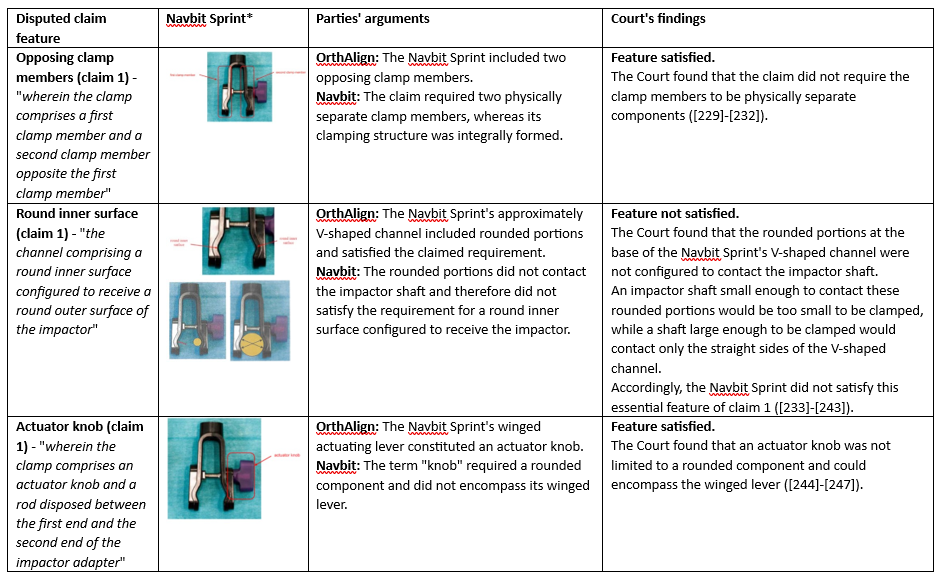
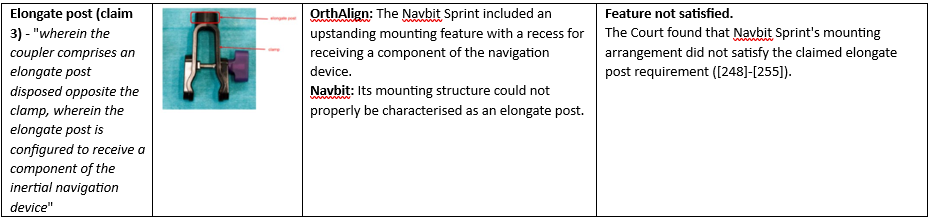
*Images reproduced from the annotated photographs considered in OrthAlign, Inc v Navbit Pty Ltd [2026] FCA 1542.
Although the Court accepted OrthAlign's arguments concerning the opposing clamp members and actuator knob, it found that the Navbit Sprint did not incorporate the required round inner surface of the channel.
This was decisive. Because the Navbit Sprint did not satisfy every essential feature of independent claim 1, the Court concluded that it did not infringe the patent. The absence of the elongate post also meant that the additional limitation of dependent claim 3 was not satisfied.
Navbit also challenged the validity of OrthAlign's patent on several grounds, including lack of support, enablement, utility, and innovative step.
As the patent was an innovation patent, it was subject to the innovative step requirement rather than the inventive step requirement applicable to standard patents.
The Australian innovation patent system was phased out on 26 August 2021 subject to transitional arrangements for existing patent applications, meaning that new innovation patent applications can no longer be filed.
Under the former system, an invention involved an innovative step unless it differed from the prior art only in ways that made no substantial contribution to the working of the invention. This is a lower threshold than the inventive step requirement for standard patents.
Of particular interest was Navbit's innovative step challenge.
Navbit argued that the claimed invention differed from earlier surgical navigation systems disclosed in the prior art only in relatively minor structural details that did not make a substantial contribution to the working of the invention.
Justice O'Bryan observed that there was “considerable force” in Navbit's arguments, particularly its contention that the differences between the claimed invention and the prior art were merely superficial or peripheral ([308]).
However, Navbit ultimately abandoned this ground of invalidity.
The Court explained that Navbit had advanced the innovative step challenge in anticipation of OrthAlign arguing that the Navbit Sprint infringed because its clamping arrangement was mechanically equivalent to the claimed arrangement.
When OrthAlign confirmed that it was not pursuing an infringement argument based on mechanical equivalence, Navbit abandoned its innovative step challenge.
The Court therefore did not reach a conclusion on whether the claims involved an innovative step.
The Court also rejected Navbit's remaining challenges concerning support, enablement and utility. Accordingly, Navbit's cross-claim for invalidity was dismissed.
The decision highlights the importance of claim wording in determining the scope of patent protection.
Although the Navbit Sprint performed a similar function to OrthAlign's patented system, differences in its clamping arrangement were sufficient to avoid infringement.
For patent applicants, the decision reinforces the importance of anticipating how competitors might achieve the same technical result using alternative structures. Claims should therefore be drafted to capture the underlying inventive concept without unnecessarily restricting protection to a particular embodiment.
For technology developers, the decision also demonstrates how carefully considered design differences may provide opportunities to develop competing products without infringing existing patents.
For more information on this decision and on the issues that it raises regarding patent infringement, claim construction and innovation patents, please contact Dr Catrina Olivera or Daniel McKinley.

We are proud members of


Office
Level 1/98 Riley Street
East Sydney NSW 2010
Australia
GPO Box 683
Sydney NSW 2001
Australia
Contact
