
.png)
The Full Court of the Federal Court has delivered an important decision concerning copyright protection for product packaging and the risks associated with deliberately “benchmarking” a competitor’s packaging.
Gestalt Law acts for Every Bite Counts (EBC), the business behind the LITTLE BELLIES range of baby and children’s snack foods, and related parties in their long-running copyright proceedings against ALDI.
A different approach to lookalike packaging
ALDI is well known for its private label products and packaging which frequently reference the appearance of established competing brands.
Until the Little Bellies proceedings, ALDI had enjoyed considerable success in Australia defending legal challenges to its lookalike products. Traditional claims based on trade mark infringement, passing off and misleading or deceptive conduct face particular difficulties where ALDI uses its own distinctive product names and branding, and consumers understand that they are purchasing an ALDI alternative rather than the branded product itself.
In acting for Little Bellies, Gestalt Law formulated a different strategy.
Rather than seeking to establish that consumers had been confused or misled as to the source of ALDI's products, the proceedings focused on the copyright subsisting in the original artistic works embodied in the Little Bellies packaging, and whether ALDI had reproduced a substantial part of those works.
That strategy succeeded.
At first instance, Justice Moshinsky found that ALDI had infringed copyright in three Little Bellies packaging works through packaging developed for its competing MAMIA range. His Honour also ordered ALDI to pay additional damages.
ALDI appealed, and the Little Bellies parties cross-appealed.
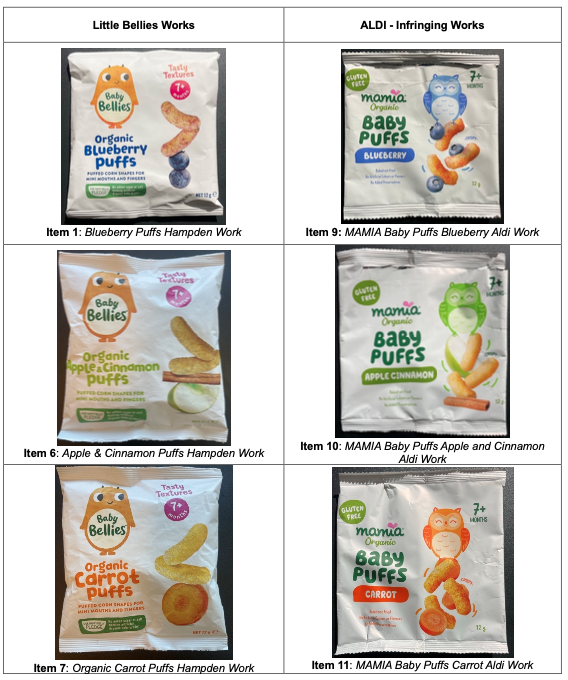
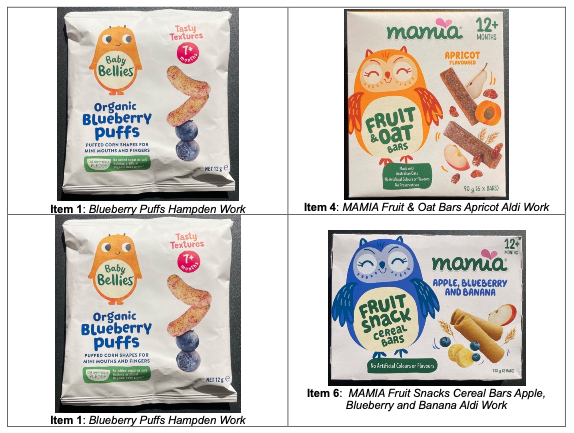
On 19 August 2026, the Full Court delivered judgment in Aldi Foods Pty Limited v Hampden Holdings I.P. Pty Limited[2026] FCAFC 103. The ultimate result was an improved one for Little Bellies: five ALDI packaging works were found to infringe, compared with three at first instance, and the award of additional damages against ALDI was upheld.
What can brand owners take from the decision?
Copyright can be a powerful tool in protecting packaging. A competitor may avoid using a brand owner's trade mark and may even avoid confusing consumers as to whose product they are buying. That does not necessarily answer the separate question of whether the competitor has copied protected artistic works used in the packaging.
The particular expression matters. Copyright does not confer exclusive rights over an idea, marketing concept, or general “look and feel”. The question is whether original expression embodied in an artistic work has been copied and whether what has been taken constitutes a substantial part of that work.
The creative history can be important. Evidence showing how packaging was conceived and developed can help establish what is original about the work and, in turn, the significance of what a competitor has taken. Brand owners should therefore retain design briefs, drafts, iterations, and communications with their designers.
Benchmarking carries risk. ALDI's design process involved using Little Bellies as a benchmark in developing competing packaging. The award of additional damages was upheld in circumstances where ALDI sought a commercial advantage from resemblance to a competitor's designs while endeavouring to remain within legal limits.
The decision therefore provides an important lesson for both sides of the equation: brand owners should consider copyright as part of the armoury available to protect distinctive packaging, while businesses developing lookalike products should not assume that avoiding consumer confusion or trade mark infringement puts them in the clear.
We are delighted to have achieved this result for Little Bellies.
Gestalt Law Principal Lance Scott and Trade Mark Attorney Clare Liang act for EBC/Little Bellies in the proceedings, together with counsel John Hennessy SC and Sam Hallahan.
The Infringing works:

We are proud members of


Office
Level 1/98 Riley Street
East Sydney NSW 2010
Australia
GPO Box 683
Sydney NSW 2001
Australia
Contact
